Guide général de voyage : Bolivie, réalisme magique
La Bolivie est une destination qui défie les sens et récompense le voyageur avec des paysages qui semblent venir d'une autre planète. C'est un pays où le temps semble s'être arrêté dans ses villes coloniales et où la nature se manifeste dans sa forme la plus pure et la plus sauvage. De la vibrante et chaotique La Paz à la sérénité du lac Titicaca, la Bolivie invite à une immersion profonde dans la vision du monde andine. C'est l'endroit idéal pour ceux qui recherchent l'aventure, l'histoire précolombienne et un véritable lien avec les racines de l'Amérique du Sud, loin du tourisme de masse.
Capital
Sucre (Constitutionnelle), La Paz (Siège du Gouvernement)
Population
11.673.021
Langue
Espagnol, QU, AY
Sites du patrimoine de l'UNESCO
0

Indices de voyage
Scores basés sur des données réelles de 0 à 100
Le meilleur de Bolivie
Expériences uniques
Traversez les salines d'Uyuni
C'est l'expérience définitive en Bolivie. Avec plus de 10 000 km², ce désert de sel offre des paysages surréalistes. Pendant la saison des pluies (janvier-mars), une fine couche d'eau le transforme en le plus grand miroir du monde, tandis que pendant la saison sèche, le sol d'hexagones de sel blanc semble infini. La visite comprend généralement l'île Incahuasi, pleine de cactus géants, et des lagons colorés peuplés de flamants roses.
Survolez La Paz en téléphérique
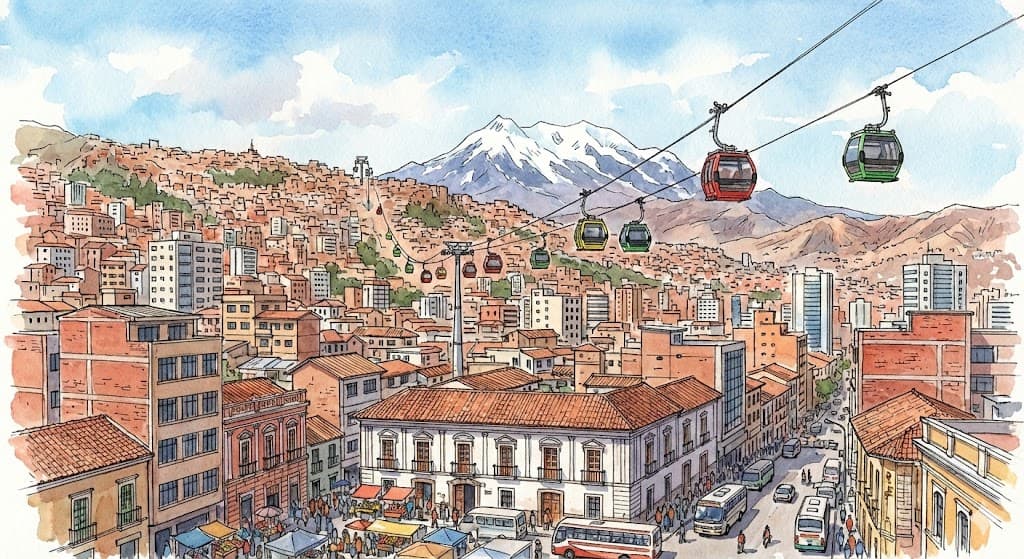
La Paz possède le réseau de téléphériques urbains le plus long et le plus haut au monde. Ce n'est pas seulement une question de transport, c'est un point de vue constant. Parcourir les lignes rouges, jaunes ou argentées permet d'observer la géographie impossible de la ville, des demeures du sud aux marchés d'El Alto, avec le majestueux Illimani aux sommets enneigés qui surveille toujours en arrière-plan.
Naviguez sur le lac Titicaca jusqu'à l'Isla del Sol
A 3 812 mètres d'altitude, le Titicaca est le lac navigable le plus haut du monde. De Copacabana, nous partons pour l'Isla del Sol, considérée comme le berceau de l'Empire Inca. Marcher sur ses sentiers préhispaniques, sans voiture et entouré d'eaux d'un bleu profond, est une expérience spirituelle et une paix absolue.
Descendez la route de la mort
Pour les amateurs d'adrénaline, la descente en VTT depuis les sommets andins (La Cumbre, 4 700 mètres d'altitude) jusqu'à la jungle des Yungas (Yolosa, 1 200 mètres d'altitude) est un incontournable. Plusieurs niveaux écologiques sont traversés, allant du froid glaciaire à la chaleur tropicale entre cascades et falaises vertigineuses.
Explorez les missions jésuites de Chiquitos
Dans les basses terres de Santa Cruz, ces missions sont les seules d'Amérique du Sud qui n'ont pas été détruites après l'expulsion des jésuites. Ses églises en bois sculpté sont des joyaux du baroque métis et restent le centre de la vie communautaire, où la musique baroque indigène résonne encore dans les festivals internationaux.
Plongez-vous dans le marché des sorcières
Au cœur de La Paz, ce marché est le centre de la médecine traditionnelle et des rituels andins. Ici vous pouvez trouver des amulettes, des herbes médicinales et les célèbres fœtus de lamas utilisés dans les offrandes à Pachamama (la Terre Mère). C'est une fenêtre fascinante sur la spiritualité bolivienne contemporaine.
Saveurs de la Terre et des Hauteurs
La cuisine bolivienne est variée, forte et profondément liée aux produits locaux tels que les pommes de terre (avec des centaines de variétés), le maïs et le quinoa. Ces dernières années, des villes comme La Paz ont connu une révolution gastronomique alliant ingrédients ancestraux et techniques modernes.
Diversité régionale
La nourriture de l'Altiplano est calorique et chaude pour lutter contre le froid, tandis qu'à l'Est (Santa Cruz, Beni) le manioc, le riz et les viandes grillées prédominent dans les climats tropicaux.
Piment bolivien
L’âme de nombreux plats est le piment (poivre séché), qui donne de la couleur et une saveur profonde, plutôt qu’un piquant excessif. Le piment jaune et le piment rouge sont les piliers de l'assaisonnement national.
Plats Iconiques
Saltena
La reine du petit-déjeuner bolivien. Il s'agit d'une empanada juteuse remplie de viande ou de poulet, de pommes de terre et de bouillon, cuite au four jusqu'à ce que la pâte soit sucrée et grillée. Il se mange à la cuillère pour ne pas gaspiller le jus.
Piqué mâle
Un plat copieux originaire de Cochabamba composé de morceaux de bœuf, de saucisses, de frites, d'oignons, de tomates et de locoto (épicé), le tout mélangé et assaisonné de sauces.
Soupe aux arachides
Probablement la soupe la plus appréciée en Bolivie. À base de cacahuètes concassées, de viande, de pommes de terre et agrémenté de frites et de persil. C'est crémeux, nutritif et réconfortant.
Silpancho
Plat composé d'une base de riz et de pommes de terre bouillies, sur laquelle est posée une feuille de bœuf très finement panée et frite, surmontée d'un œuf au plat et d'une salade de tomates et d'oignons.
majadito
Typique de l'est de la Bolivie, il s'agit de riz à la charque (viande déshydratée), accompagné d'œuf au plat et de plantain frit. Il existe une version « secouée » (plus humide) ou « grillée ».
Boissons typiques
Singani
Le distillat national de Bolivie, élaboré à partir de raisins Moscatel de Alejandría cultivés à haute altitude. C'est la base du célèbre cocktail 'Chuflay' (Singani, Ginger Ale et citron).
Chicha de Maïs
Boisson fermentée traditionnelle d'origine inca, à base de maïs. Il est très populaire dans les vallées de Cochabamba et est consommé dans les endroits signalés par un drapeau rouge sur la porte.
Mocochinchi
Boisson gazeuse rafraîchissante à base de pêches séchées bouillies avec de la cannelle et du sucre. Il est servi très froid et on le trouve couramment sur les étals de rue à travers tout le pays.

Vins d'altitude
La Bolivie produit des vins dans la région de Tarija, à plus de 1 800 mètres d'altitude, ce qui leur confère une concentration d'arômes et de saveurs unique au monde.
Desserts traditionnels
Glace à la cannelle
Un sorbet artisanal rouge profond, très traditionnel sur les marchés de La Paz, qui est généralement accompagné d'une empanada (gâteau) au fromage chaud.
Cuñape
Des petits pains à la fécule de manioc et beaucoup de fromage, typiques de l'Orient. Ils sont croustillants à l'extérieur et élastiques à l'intérieur, idéaux pour l'heure du café.
Que voir par thème
Des hauteurs glaciales à la chaleur humide de la jungle, la Bolivie propose des itinéraires pour tous les types d'explorateurs.
Patrimoine colonial et républicain
Sucre et Potosí sont des arrêts obligatoires. Sucre enchante par ses façades blanches et ses musées historiques, tandis que Potosí impressionne par son imposant Cerro Rico et la Casa de la Moneda, rappelant l'époque où elle était l'une des villes les plus riches et les plus peuplées du monde.
Aventure en Amazonie
Rurrenabaque est la porte d'entrée du parc national Madidi et de la Pampas del Yacuma. Ici vous pouvez voir une faune incroyable : des jaguars, des dauphins roses, des alligators et des centaines d'espèces d'oiseaux dans l'un des écosystèmes les plus riches en biodiversité de la planète.
Mystères précolombiens
Tiwanaku, près de La Paz, révèle les secrets d'une civilisation qui dominait les Andes des siècles avant les Incas. La Puerta del Sol et les monolithes de pierre sont des témoignages d'ingénierie et d'astronomie avancées.
Nature Extrême et Lagons
La réserve Eduardo Avaroa, au sud du Salar de Uyuni, abrite la Laguna Colorada (rouge pour les algues) et la Laguna Verde, ainsi que des geysers actifs et des formations rocheuses comme l'Arbre de Pierre, dans un environnement volcanique époustouflant.
Conseils de voyage
Mal des altitudes (Soroche)
De nombreuses régions de Bolivie se situent au-dessus de 3 500 mètres. Il est essentiel de s'acclimater, de boire beaucoup d'eau, d'éviter l'alcool les premiers jours et d'essayer le thé de coca, un remède naturel très efficace.
Transport
Les bus interdépartementaux (« fletas ») constituent le principal moyen de déplacement. Pour les longues distances, les bus « couchettes » sont recommandés. Dans les villes, les minibus et les trufis sont courants, mais le téléphérique de La Paz est l'option la plus confortable.
Devise et paiements
La monnaie officielle est le Boliviano (BOB). Bien que les hôtels et les grands restaurants acceptent les cartes, il est indispensable d'avoir sur soi de l'argent liquide en petites coupures pour les marchés, les transports et les villes rurales.
Connectivité
Le Wi-Fi s'est beaucoup amélioré dans les principales villes, mais dans les zones reculées comme le Salar de Uyuni ou la jungle, la connexion est inexistante ou très limitée. Il est recommandé d'acheter une carte SIM locale (Entel possède la meilleure couverture rurale).
La Bolivie n’est pas seulement une destination, c’est un voyage de transformation. Sa beauté brute et sa culture inchangée offrent une perspective unique sur l’Amérique du Sud. Nous vous recommandons de planifier avec flexibilité, de respecter les traditions locales et de vous laisser emporter par le rythme lent des Andes. Votre aventure au cœur du continent vous attend !
Chargement peut-être...
Avant de partir
Réponses rapides pour planifier votre voyage en toute confiance
- 60Sécurité
- 30Abordable
TripPlanner
Créez votre itinéraire parfait
Chargement...
Votre profil de voyageur
Découvrez votre style de voyage
Chargement...